
What is Blepharospasm?
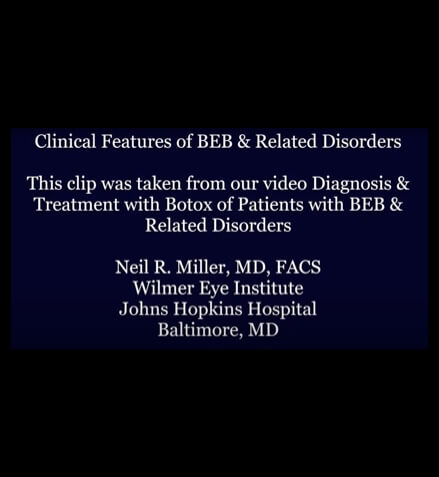
Blepharo means “eyelid”. Spasm means “uncontrolled muscle contraction”. The term blepharospasm [blef-a-ro-spaz-m] can be applied to any abnormal blinking or eyelid tic or twitch resulting from any cause, ranging from dry eyes to Tourette’s syndrome to tardive dyskinesia.
The blepharospasm referred to here is officially called benign essential blepharospasm (BEB) to distinguish it from the less serious secondary blinking disorders. “Benign” indicates the condition is not life-threatening, and “essential” is a medical term meaning “of unknown cause”. It is both a cranial and focal dystonia. Cranial refers to the head and focal indicates confinement to one part. The word dystonia describes abnormal involuntary sustained muscle contractions and spasms. Patients with blepharospasm have normal eyes. The visual disturbance is due solely to the forced closure of the eyelids.
About the BEBRF

The purpose of the BEBRF is “…to undertake, promote, develop and carry on the search for the cause, a cure, and [treatments] for benign essential blepharospasm and other related disorders and infirmities of the facial musculature…” (Mattie Lou Koster, Founder).
The Foundation is the only organization solely dedicated to finding the cause and a cure for blepharospasm and Meige. It is a volunteer non-profit organization that relies entirely on public and private charitable donations. It is not endowed or supported by federal or local governments. It is an Exempt Organization under Section 501(c)(3) of the IRS.
Research

A major part of the charter of the BEBRF is to support research into causes, cures, and treatments for blepharospasm. The BEBRF provides seed funding or partial funding for research projects through an annual call for research proposals.
Our Mission
Sponsorship of Research – a commitment to raising monies through charitable donations to be directed toward the research required to discover the cause, better treatments, and the cure for blepharospasm, Meige, and other related disorders of the facial musculature.
Patient Support – provided through a network of support groups in all parts of the country and internationally, that brings patients together to share experiences, receive encouragement, and get direction to centers for treatment.
Information and Education – designed to create an awareness of blepharospasm, Meige, hemifacial spasm, and other related disorders of the facial musculature in the medical community and the general public and to promote the distribution of information and enhancement of continuing medical education regarding these disorders.
What’s New?
Date: Monday, May 20, 2024 Time: 1pm-3pm central Location: Zoom Please contact Charlene for invitation instructions to meeting. Contact…
Date: Tuesday, October 15, 2024 Time: 12 noon-2pm central Location: Zoom Please contact Ena Wilmot for invitation instructions to…
Date: Tuesday, June 18, 2024 Time: Noon, Central Time Location: Zoom Please contact Ena Wilmot for invitation instructions to…
10th December 2024
Date: December 10, 2024 Time: 12 pm central Location: 1215 E. Yellow Jacket Ln. …
Date: Monday, May 20, 2024 Time: 1pm-3pm central Location: Zoom Please contact Charlene for invitation instructions to meeting. Contact…
Date: Tuesday, October 15, 2024 Time: 12 noon-2pm central Location: Zoom Please contact Ena Wilmot for invitation instructions to…